What is the simplest off camera flash setup that works at a wedding?
One light on one stand, and the guide number arithmetic that tells you where to put it: every calculation shown in full, every number either quoted from a spec sheet or derived where you can check it.
KEY TAKEAWAYS
- One flash on one stand, 45 degrees off camera, is the whole first setup. Direction is what you are buying; everything else is refinement.
- The guide number is just f number times distance. One division answers the two questions that matter: what aperture from here, and how far back can I stand at the aperture I want.
- Two counterintuitive results, both derived below where you can check them: doubling your ISO twice buys only one stop of distance, and at close range a single step backward costs about a stop.
- A quoted recycle time without its test conditions is close to meaningless. The honest spec includes the duty cycle, and we show what one actually looks like.
What one light off camera buys you
The previous chapter ended where every hotshoe technique ends: the light still starts at the camera. Move the flash to a stand and you choose the light’s direction independently of where you stand, which means shape on faces, separation from the background, and the option to light the couple through the rain, the first dance, or a dark corner the venue forgot. The cost is carrying a stand, a trigger, and the arithmetic below, which is shorter than it looks.
The first setup, and the one in Fig 3.1: flash on a stand at head height or a little above, about 45 degrees off the camera axis, aimed at the subject, bare or with a small modifier. Trigger on the hotshoe. That is it. Resist the urge to add a second light until this one is boring; the kit chapter covers what to buy when it is.
Guide numbers, honestly
A guide number is the manufacturer’s statement of reach: the standard reference defines it as f number times subject distance, at a stated ISO.1 So GN 60 in meters at ISO 100 means: at 5 meters, about f/12 worth of light. The spec sheet fine print is load bearing, because a guide number is only valid at one zoom setting and one ISO. Nikon states the SB-5000’s as 34.5 meters at the 35mm zoom position and 55 at 200mm, at ISO 100, 23 degrees C, FX format, standard illumination pattern.2 That fully conditioned sentence is what a trustworthy guide number looks like. Godox states the AD200Pro II at GN 52 in meters, ISO 100, at 35mm with its speedlite head, and GN 60 with the bare bulb head and its standard reflector at 28mm.3 Same unit, two heads, two numbers: the conditions are the spec.
One more honest note from the same reference: automatic flash replaced guide number arithmetic with variable output, so if you shoot TTL you are not using guide numbers at all.1 The arithmetic below is directly actionable in manual mode, and worth knowing in any mode, because it is the model that explains why your flash behaves as it does.
The arithmetic, shown in full
What aperture from here? GN 60 flash, subject about 5 meters away: 60 divided by 5 is 12, so about f/12, and the nearest real stop is f/11, a quarter stop out. One division and a rounding call.
How far back can I stand? Rearrange it. You want f/8 for a group: 60 divided by 8 is 7.5, so about 7.5 meters, roughly 25 feet. This rearrangement is the one you will actually use at a reception, because the aperture is usually chosen before the flash is.
What does ISO buy? The reference states that doubling the ISO multiplies the guide number by about 1.4, and quadrupling it doubles the guide number.1 So at ISO 400 our GN 60 flash behaves like GN 120: at 5 meters, 120 divided by 5 is 24, about f/22. The counterintuitive part is worth saying plainly: because the guide number grows with the square root of ISO, two stops of ISO buys only one stop of distance. ISO is a strong lever on aperture and a weak lever on reach.
What does distance cost? Light from a small source falls with the square of distance, so the cost in stops of moving from one distance to another is twice the log base 2 of the ratio. Doubling, 5 meters to 10, costs exactly 2 stops. Real rooms rarely double: 2.5 meters to 3.5 is a ratio of 1.4, and twice the log base 2 of 1.4 is about 1 stop. The rule to carry without arithmetic: at close range, one step backwards is about a stop. It is also why the far end of a group goes dark when the light is close: the falloff across the group is the same arithmetic.
One precondition travels with all of this, and the reference states it explicitly: the inverse square rule strictly applies to point sources, and approximates only sources small in proportion to their distance.1 A bare flash qualifies. A softbox is deliberately built not to: it is a large source on purpose, so within a few multiples of its own size, which is exactly portrait distance, the tidy arithmetic degrades. No published efficiency figure for softboxes and umbrellas made it into our source record either, so when you add a modifier, go back to test frames. The math got you to the neighborhood; the histogram parks the car.
The recycle time trap
Spec sheets quote recycle times, and the number circulating is usually missing its conditions. Nikon’s Japanese specification for the SB-5000 states a minimum of approximately 2.6 seconds on four alkaline cells, or approximately 1.8 seconds on NiMH, measured at manual full output, 23 degrees C, under the CIPA procedure.2 The SB-700 page adds the condition the internet always drops: the measurement fires once every 30 seconds on fresh batteries at 20 degrees C.2 A flash asked to fire every 3 seconds through a first dance is nowhere near that duty cycle. Quote the condition or distrust the number; at a wedding, keep power at 1/8 or below where you can, and recycle stops being the constraint.
Starting points
| SCENARIO | ISO | SHUTTER | APERTURE | FLASH | CHANGE THIS FIRST |
|---|---|---|---|---|---|
| Portrait at dusk, flash 3 m at 45° | 200 | 1/200 | f/2.8 | 1/16 | Flash power, ⅓ stops |
| Group of 8, flash 5 m, near the camera | 400 | 1/160 | f/5.6 | 1/4 | Distance, to even the falloff |
| Reception corner light, aimed at dance floor | 1600 | 1/160 | f/2.8 | 1/16 | Stand position, not power |
| Dark exterior, couple under cover | 800 | 1/125 | f/2.8 | 1/8 | Flash power, watch the highlights |
Starting estimates. Assumes a full frame body, one manual flash with a guide number around 60 meters at ISO 100 zoomed to 35mm, fired bare from a stand. Every row expects correction from a test frame; distances change the answer by the inverse square arithmetic above, so move the light before you move the power when the shape is wrong.
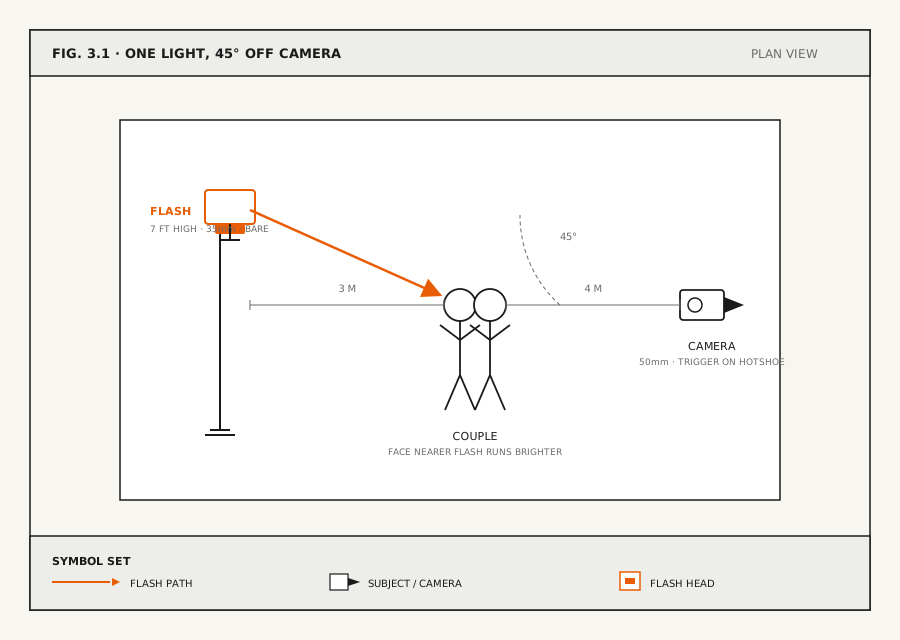
- SUBJECT: couple, standing, facing camera
- FLASH: on a stand, 7 ft high, 3 m from subject, 45° camera left
- HEAD: zoomed to 35mm, aimed at the couple’s faces, bare
- CAMERA: 4 m from subject, 50mm, trigger on hotshoe
- START: about 1/16 power at ISO 200, f/2.8 · check: 60 ÷ 3 suggests the flash has aperture to spare
- FALLOFF: whichever face is nearer the flash runs brighter; angle the stand to even it
The guide number arithmetic holds for a bare flash aimed at the subject. It does not survive bounce, softboxes, or umbrellas: bounce fails for the reasons the previous chapter shows in full, and large modifiers violate the point source condition by design. It also assumes the guide number’s own conditions, the stated zoom and ISO; change either and the number silently changes with it. Where the math stops, the test frame takes over.
Frequently asked
Do I need an assistant to shoot off camera flash?
No. A stand with a wide base, sandbagged or wedged, does the job for the static setups in this chapter. An assistant becomes worth it when the light needs to move with you, which at most weddings is only the dance floor.
Should my first flash be a speedlight or a bigger strobe?
For a first light, a manual speedlight with a published, fully conditioned guide number is enough, and it doubles as your on camera flash. Bigger units buy headroom through modifiers and faster duty cycles, not a different kind of picture. The kit chapter covers the tradeoffs without price tags that would be stale in a month.
TTL or manual for the off camera light?
Manual. The whole point of the stand is a light that holds still while you move, and manual holds the exposure still with it. TTL re meters as you reframe, which reintroduces exactly the frame to frame drift you left the hotshoe to escape.
Why does the far side of my group go dark?
Inverse square falloff across the group: the ratio of far to near distance sets the difference in stops, twice the log base 2 of it. Fix it with distance, not power. Pull the light back so the near to far ratio shrinks, or walk it around closer to the camera axis so everyone stands at roughly the same distance from it.
SOURCES
- Jacobson, R.E., Ray, S.F., Attridge, G.G. and Axford, N.R., The Manual of Photography: Photographic and Digital Imaging, 9th edition, Focal Press, 2000. The guide number relation, the ISO scaling factors, the inverse square rule and its point source condition, and the note that automatic flash replaced guide number arithmetic are all stated there; paraphrased because the freely readable copy is a scanned text.
- Nikon SB-5000 and SB-700 Speedlight specifications, imaging.nikon.com. The fully conditioned guide numbers are on the English pages; the recycle time tables with their duty cycle conditions are on Nikon Japan’s specification pages for the same units, fetched 2026-08-04.
- Godox AD200Pro II product specifications, godox.com. Both per head guide numbers with their full conditions are from its Tech Specs table, fetched 2026-08-04.