How do you shoot a dark church wedding when flash is banned?
How dark a church really is, why the light that exists misses faces by design, and the discipline that gets sharp frames anyway: metering for the dress, a real shutter floor, and ISO chosen without folklore.
KEY TAKEAWAYS
- Design guidance for churches targets roughly 100 to 200 lux in the nave. That is a design ceiling, not a measurement of your church, and real churches during weddings often run darker.
- Lighting engineers name a common failing of church lighting: it meets its numbers on horizontal surfaces while the vertical plane goes underlit. A face is a vertical plane. That is why the room looks brighter than the portraits come out.
- Meter, then check the dress highlights on the histogram. The meter’s 18 percent assumption fails hardest in exactly this room.
- Hold shutter speed for the moment, open the aperture to its limit, and let ISO land where those two force it. Noise is recoverable; motion blur on the vows is not.
How dark is a church, honestly
Start with the only numbers anyone publishes, and their honest label. Guidance for Church of England buildings, attributing its figures to the professional body for building services engineers, recommends around 100 to 200 lux for the main body of a church, 300 at the pulpit or lectern, and 200 for the chancel.1 Those are design targets: what a church should be lit to, measured nowhere. No measured dataset of real churches during weddings made it into our source record, and we will not pretend one exists. What the design numbers still give you is the order of magnitude, and it is low: for comparison, a published measured study using a calibrated lux meter found a median of 9,300 lux outdoors under open sky and 179 lux pooled across ordinary indoor locations.2 A church designed to its guidance sits at ordinary indoor darkness; a historic building with dimmed fixtures and a vaulted ceiling can sit well below its own guidance, and often does.
Why faces are darker than the room
Here is the finding that explains more dark church disappointment than any lux figure. The Society of Light and Lighting, writing on religious buildings, states that a common failing of lighting in Christian churches is low illuminance on the vertical plane: a space can meet its recommendations measured on horizontal surfaces while the vertical plane is much reduced and markedly non uniform, and the problem is more sensitive in buildings with high ceilings.3 Design illuminance is specified on horizontal surfaces, the floor and the pew and the open book. A face is a vertical plane. So a church can fully meet its lighting spec and still underlight every face in it, and the professional body says that failure is common, and worst in exactly the high ceilinged buildings weddings happen in.
The practical consequences: trust nothing you metered off the floor or the pews; find the light that does land vertically, a window, a chandelier’s side throw, the lectern spot, and put faces where it falls; and when the couple face each other at the altar, expect one face lit and one in shadow, because vertical light in these buildings is not just scarce but uneven. Positions that put your lens on the lit side of a face are worth more than a stop of ISO.
Metering around the dress
The natural light chapter covers the meter’s 18 percent reflectance assumption in full; the dark church is its worst case. A white dress inside a dark stone and timber interior is nearly the textbook failure the standard reference warns about, with errors approaching a stop in either direction depending on what dominates the frame.4 The procedure is the same and matters more here: meter, take the frame, read the histogram’s right edge where the dress lives, set exposure so those highlights sit just short of clipping, then hold that exposure while the light holds. In a church the light mostly holds, which is the one mercy of the venue: you can set once per position and spend your attention on the moment.
ISO without folklore
The order of operations is fixed by what cannot be recovered. Motion blur on the vows cannot. So: choose the slowest shutter you trust for the moment, roughly 1/250 for a processional with a long lens, slower for still readings if your hands and stabilization allow. Open the aperture to its limit. Then set ISO to whatever makes the exposure correct, and stop negotiating with it. A noisy sharp frame is a photograph; a clean blurred one is not.
One folklore trap deserves a plain sentence. The internet will tell you your camera has a second base ISO or a dual gain crossover at some magic value. We checked the manufacturer specifications and manuals for thirteen current and recent bodies across Canon, Nikon, Sony, and Fujifilm: every one publishes a single ISO range plus expanded values, and none publishes gain stages or the term base ISO at all.5 Whatever truth third party lab measurements hold, none of it is manufacturer spec, and none of it should outrank the order of operations above. One cited oddity worth knowing if you shoot Fujifilm: the X-T5’s standard range starts at ISO 125, with 100 available only as an extended setting.5
Silence is the other constraint flash bans travel with. Electronic shutter solves the noise and brings its own tradeoffs, and one is worth quoting before a ceremony: on Nikon’s Z6 III, flash sync with the electronic shutter is specified at 1/60, far below its mechanical sync.5 No flash in the ceremony makes that moot, but remember it exists the moment the reception starts and the flash goes back on: the quiet shutter mode you enabled at 2pm can quietly cap your sync at 7pm.
Starting points
| SCENARIO | ISO | SHUTTER | APERTURE | FLASH | CHANGE THIS FIRST |
|---|---|---|---|---|---|
| Processional, 70 to 200mm, moving subjects | 6400 | 1/250 | f/2.8 | None allowed | ISO up before shutter down |
| Vows at the altar, subjects still | 3200 | 1/160 | f/2.8 | None allowed | Position, find the vertical light |
| Readings, lectern spot on the reader | 1600 | 1/200 | f/2.8 | None allowed | Meter the spot, not the room |
| Candlelit evening ceremony | 12800 | 1/125 | f/1.8 | None allowed | Nothing: accept the noise |
Starting estimates. Assumes a full frame body and f/2.8 zoom or faster prime, no flash, raw capture. Churches vary enormously and often sit below their own design guidance, so every row expects immediate correction from the histogram with the dress highlights as the reference. Read times of day, window light, and dimmer settings move these by whole stops.
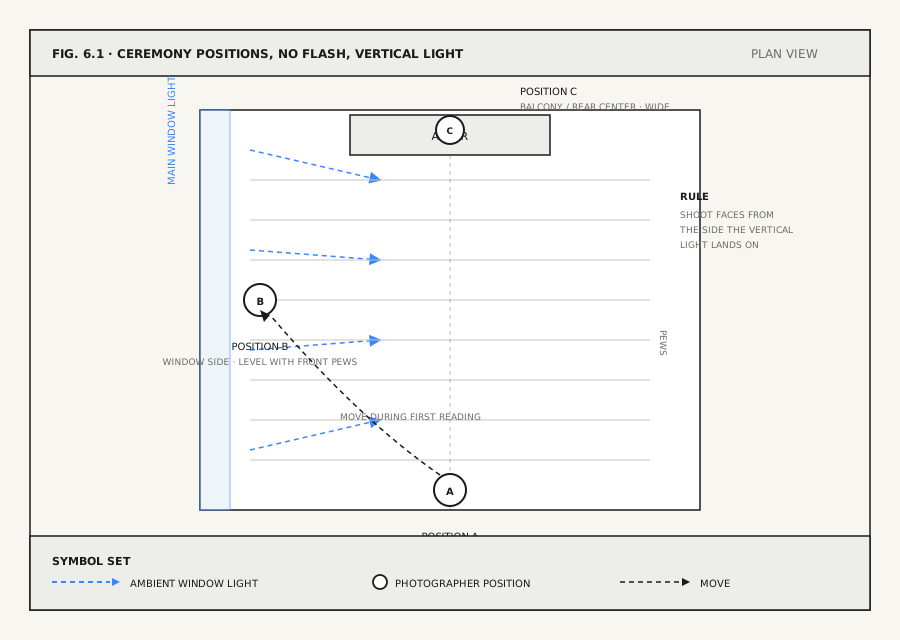
- NAVE: center aisle, altar at top · main window light entering from the south side
- POSITION A: back of the aisle, 70 to 200mm, for the processional
- POSITION B: side aisle on the WINDOW side, level with the front pews, for vows
- RULE: shoot faces from the side the vertical light lands on
- POSITION C: balcony or rear center if permitted, wide, for the room
- MOVE: A to B during the first reading, along the side aisle, once
The lux figures here are design guidance and a general indoor measurement study, not measurements of any church, and your building can sit stops away from both; the settings rows are estimates seeded from those figures, not exposures recorded at a real ceremony. We considered converting the design lux bands into exposure values and decided against publishing that arithmetic: the conversion needs a calibration constant we could not source to our standard. When we can cite it, the derivation will appear here with its work shown.
Frequently asked
The officiant says no flash and no movement. Is one position enough?
Yes, if you choose it for the light rather than the geometry. The window side of the front third of the nave covers processional, vows, rings, and the kiss with one long lens. Ask exactly what movement is permitted before guests arrive; walk the move once during the rehearsal or the prelude, quietly and without the camera raised.
Should I underexpose to keep my shutter speed and fix it in post?
Deliberately underexposing about a stop and raising it in the raw file is a legitimate last resort, and it costs you in the shadows where a dark church already lives. Try the honest ISO first. The frames that force real underexposure are the moving ones, and those are exactly the frames where the shutter floor is not negotiable.
Is a monopod worth bringing into the ceremony?
With a 70 to 200mm at slow shutter speeds, yes: it steadies the long end without a tripod’s footprint or setup noise, and most officiants who ban flash do not object to one used quietly from a fixed position. It does nothing for subject motion, so the shutter floor for moving people stands.
SOURCES
- Church of England, ChurchCare guidance on church lighting, churchofengland.org, which attributes its recommended illuminance figures to CIBSE. Design guidance, not measurements; fetched 2026-08-04.
- Bhandary, S.K., Dhakal, R., Sanghavi, V. and Verkicharla, P.K., “Ambient light level varies with different locations and environmental conditions”, PLoS ONE, doi.org/10.1371/journal.pone.0254027. The measured outdoor and pooled indoor medians are from its tables.
- Society of Light and Lighting, “Lighting of religious buildings”, published by the Institution of Engineering and Technology, electrical.theiet.org. The vertical plane findings quoted are from this document; fetched 2026-08-04.
- Jacobson, R.E., Ray, S.F., Attridge, G.G. and Axford, N.R., The Manual of Photography, 9th edition, Focal Press, 2000, on reflected meter calibration to 18 percent and the resulting errors for far lighter or darker subjects; paraphrased because the freely readable copy is a scanned text.
- Manufacturer specifications surveyed 2026-08-04: Canon R6 Mark II and R8 Advanced User Guides; Nikon Z6 III, Z6 II, and D750 specification pages; Sony a7 III and a7 IV Help Guides; Fujifilm X-T5 specifications. None publishes dual gain stages or the term base ISO; the X-T5 standard range and the Z6 III electronic shutter sync figure are stated on their respective pages.