How do you read the light in a venue before you shoot in it?
Direction, quality, and distance: the three things to read in any room before you raise the camera, plus the measured reason two places that both look like shade can be nine stops apart.
KEY TAKEAWAYS
- Read three things in order: where the light comes from, how big the source is, and how fast it falls off. Everything else is a consequence of those three.
- Shade is not one thing. In a published measured dataset, light under a translucent canopy barely dropped at all, while the gap between buildings fell to the level of a dim interior. The difference between two kinds of shade can exceed nine stops.
- Your meter assumes the world is 18 percent gray. A white dress is not, so meter, then check the dress highlights on the histogram, not the overall exposure.
- One test frame answers questions a paragraph of theory cannot. Take it before the couple is standing in place.
The three questions to ask of any room
First: where is the light coming from? Walk in and find the brightest sources: windows, doorways, skylights, fixtures. Light has direction even when it looks flat, and the direction decides where a face can turn and still have shape. Put the subject so the main source lands at an angle to the face rather than dead behind it or dead above it.
Second: how big is the source, from where the subject stands? A large source relative to the subject gives soft edges to shadows; a small one gives hard edges. A window is big when the subject is close to it and effectively small from across the room. This is why the same window is flattering at six feet and ordinary at thirty.
Third: how fast does the light fall off? Step a subject away from a window and watch the exposure drop frame by frame. Be careful with the arithmetic here: the tidy inverse square rule is stated for point sources, and the standard reference is explicit that it only approximates sources that are small in proportion to their distance.1 A big window close up is not a point source, so do not compute the falloff. Walk it with a test frame at each position instead; the camera will tell you in three frames what no formula here honestly can.
Shade is not one thing, and the difference is measured
A study in PLoS ONE measured ambient light with a calibrated lux meter across outdoor and indoor locations.2 In an open playground under open sky the median was 9,300 lux, with readings up to 93,500. Under a translucent artificial shade the median was 8,180 lux. That drop, 9,300 to 8,180, is a factor of about 1.14, which is roughly a fifth of a stop: a canopy that reads as shade to your eye barely dents the exposure.
The same study measured the space enclosed between buildings at a median of 11 lux, which the authors call similar to indoor levels. Compare the two kinds of shade: 8,180 divided by 11 is about 744, and every doubling is one stop, so that gap is about nine and a half stops. You can check the arithmetic: two to the ninth power is 512 and two to the tenth is 1,024, and 744 sits between them. Two places a photographer would both call shade can be more than nine stops apart.
The practical rule that falls out of the measurement: open shade with a view of the sky keeps most of the light and softens it, which is what you want for faces at noon. Enclosed shade between walls is not a softer version of the same thing, it is a different room with almost no light in it. When you scout, sort every shaded spot into one of those two bins before you promise portraits there. The outdoor exposure chapter builds on exactly this split.
Indoors, the same dataset pooled to a median of 179 lux across indoor locations. That is dim: dimmer than almost anywhere outdoors short of the enclosed gap between buildings. Walking from open sky to an average interior costs several stops, which is why the walk from portraits outside to the reception room feels like entering a cave until your settings catch up. The dark church chapter covers the extreme end of this.
When the meter lies to you
Your camera meter is calibrated on the assumption that the scene averages about 18 percent reflectance, and the standard reference notes that subjects far from that assumption can produce exposure errors approaching a stop in either direction.1 A wedding hands you the failure case on purpose: a white dress beside a dark suit, often in a dark paneled room. The meter sees the dress and pulls the exposure down; the dress goes gray and the room goes black.
- Meter the scene however you normally do, and take the frame.
- Read the histogram, and look at the right edge, where the dress lives. You want the dress bright but not clipped.
- Adjust exposure until the dress highlights sit just short of the edge, and stop trusting the meter needle for the rest of that room.
- Re run the check when the light changes, not every frame.
Starting points, not answers
These rows are starting estimates for a test frame, nothing more. Natural light varies too much for a table to be an answer, which is the whole reason the reading skill above matters more than any preset.
| SCENARIO | ISO | SHUTTER | APERTURE | FLASH | CHANGE THIS FIRST |
|---|---|---|---|---|---|
| Window portrait, subject 6 ft from glass | 400 | 1/250 | f/2.8 | None | Distance to the window |
| Open shade, sky visible overhead | 200 | 1/500 | f/2.8 | None | Shutter, watch the histogram |
| Enclosed shade between walls | 1600 | 1/250 | f/2.0 | None | ISO, this is interior light |
| Indoor ambient, average room | 1600 | 1/160 | f/2.0 | None | Shutter, down to your handheld floor |
Starting estimates for a first test frame. Assumes a full frame body and a 35mm or 50mm prime in the described light. Every row expects you to correct from the histogram, dress highlights first. Nothing here is a measured exposure of any real venue.
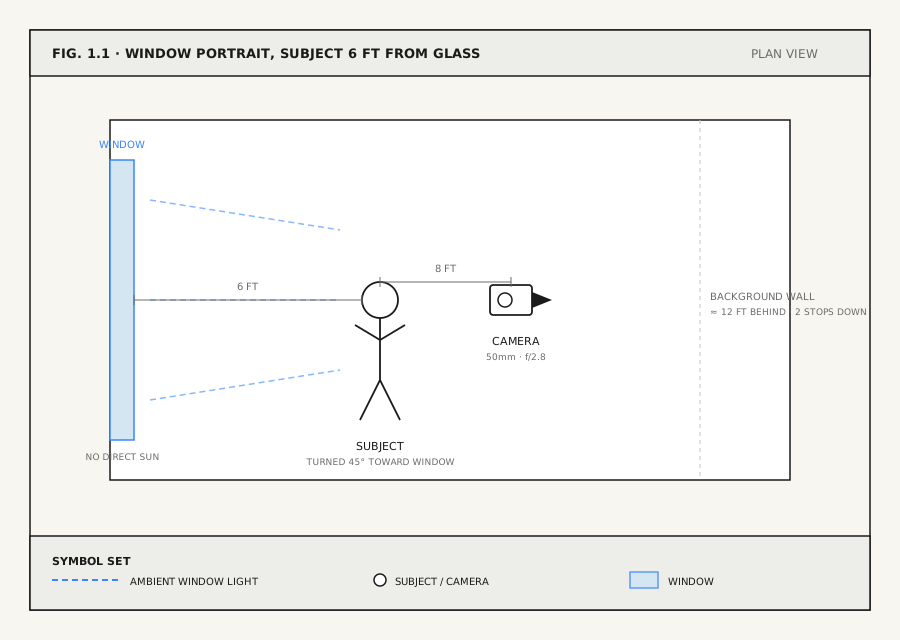
- WINDOW: full height, no direct sun through it, on the subject’s left
- SUBJECT: standing 6 ft from the glass, turned 45° toward it
- CAMERA: 8 ft from subject, window side, 50mm at about f/2.8
- FALLOFF: background wall 12 ft behind subject goes about 2 stops down
- NO FLASH · NO REFLECTOR · AMBIENT ONLY
The lux figures above are measurements from one published study, made outdoors and indoors in daylight with a calibrated meter; they are the best measured anchors we have found, but they are not measurements of wedding venues, and your venue will differ. The settings rows are starting estimates, not exposures anyone recorded at a wedding. Where a number could not be sourced or derived, this chapter teaches the check instead: that is deliberate.
Frequently asked
Do I need a handheld light meter for weddings?
No. The camera meter plus the histogram covers wedding work, provided you know the 18 percent assumption and check the dress highlights rather than trusting the needle. A handheld incident meter is a fine tool, but it reads one position at one moment, and wedding light moves.
What is the single most useful natural light position?
Subject close to a big window with no direct sun through it, turned partway toward the glass, photographer between the subject and the light side. It is repeatable in almost any venue, and it is the setup in Fig 1.1.
How do I practice reading light without a wedding to shoot?
Walk any room at home at three times of day and predict, before raising the camera, which direction the light comes from, how soft it is, and how fast it falls off. Then take test frames and score yourself. The skill transfers directly because the questions never change.
SOURCES
- Jacobson, R.E., Ray, S.F., Attridge, G.G. and Axford, N.R., The Manual of Photography: Photographic and Digital Imaging, 9th edition, Focal Press, 2000. The point source condition on the inverse square rule and the 18 percent meter calibration assumption are both stated there; we paraphrase rather than quote because the freely readable copy is a scanned text.
- Bhandary, S.K., Dhakal, R., Sanghavi, V. and Verkicharla, P.K., “Ambient light level varies with different locations and environmental conditions: Potential to impact myopia”, PLoS ONE, doi.org/10.1371/journal.pone.0254027. Measured with a factory calibrated lux meter; the open sky, translucent shade, between buildings, and indoor medians quoted above are from its tables.