How do you expose golden hour, and survive harsh midday sun?
The two outdoor extremes of a wedding day, on one exposure logic: measured numbers for how bright daylight and shade really are, the real cost of fighting sun with flash, and the overcast plan B without the myth.
KEY TAKEAWAYS
- Measured under open sky, daylight ran a median of 9,300 lux and peaked at 93,500 in one calibrated study: the outdoors swings across a range of many stops between days, which is why outdoor exposure is a cadence of checks, not a setting.
- Golden hour is a moving target. No published measurement of how fast it falls made it into our source record, so this chapter teaches the re metering cadence instead of pretending a timetable exists.
- At midday, choose shade by what it does, not what it looks like: a translucent canopy costs about a fifth of a stop, enclosure between walls can cost nine or more. Both figures are measured, shown below.
- Fighting sun with flash above sync speed costs real output: about a stop and a half at 1/125 on the one flash whose maker publishes the table. Derived below, checkable.
How bright is daylight, measured
One published study measured ambient light with a factory calibrated lux meter across real locations: under open sky in a playground the median was 9,300 lux with a maximum of 93,500, and a companion figure it cites puts a dark cloudy day at 3,896 to 7,559 lux.1 Two working conclusions fall out. First, the sheer range: even the same location under the same sky runs a wide band, and between a dark overcast and full sun the ratio can approach ten, more than three stops. Second, a comparison you can check: 9,300 over 3,896 is about 2.4, and the log base 2 of 2.4 is about 1.3, so a typical sunny to cloudy swing is on the order of one to one and a half stops, with the extremes far wider. The camera’s meter and histogram handle this fine; the point of knowing the numbers is to stop being surprised by how often outdoors demands a new reading.
Golden hour: the mechanics without the mythology
In the last hour before sunset the sun sits low, travels through more atmosphere, and arrives warmer, softer edged, and dimmer, dropping toward the horizon while you work. Here is what we cannot give you, plainly: no published time series of how fast the light falls through that hour made it into our source record, so you will not get a minute by minute exposure table from us, and you should distrust one anywhere else unless it names its instrument and its day. What replaces the table is a cadence and a single equivalence.
The equivalence: a stop is a stop wherever you spend it. One stop of falling light can be paid with one stop of aperture, of shutter, or of ISO, in any mix; the standard reference’s exposure value arithmetic reduces to exactly that factor of two equivalence.2 So decide before the hour which dial pays first. A working default: hold aperture for the look, pay with shutter down to your handheld floor, then pay with ISO and stop worrying. The cadence: re check the histogram at every position change, and between positions any time the sun visibly touches the horizon line, because the drop accelerates at the end. Backlit at golden hour, the meter fails the same way it fails a white dress: expose for the faces and check them on the histogram, and let the sky do what it wants.
Harsh midday sun: choose shade by what it does
High sun digs eye sockets into shadows and clips white fabric. The classic escape is shade, and the measured study above is the honest guide to which shade, because its shade findings are the useful surprise: under a translucent artificial canopy the median was 8,180 lux against 9,300 in the open, a drop of about a fifth of a stop, while the gap enclosed between buildings fell to a median of 11 lux, about nine and a half stops down, at the level of a dim interior.1 The full arithmetic is in the natural light chapter; the consequence belongs here. Open shade with sky overhead keeps daylight exposure with soft light: that is where midday portraits live. Deep enclosure is a different room needing interior settings, and treating the two as one word, shade, is how midday galleries end up half rescued and half black.
The other midday option is to fight the sun with flash: backlight the couple, then bring flash up to carry their faces against the bright background. Below sync speed this is the off camera chapter’s arithmetic with the ambient set to bright. Above sync speed, high speed sync opens the shutter range and quietly taxes the flash. On the one unit whose maker publishes the full table, Canon’s EL-1, the normal guide number of 60.0 meters at 200mm and ISO 100 becomes 37.3 in high speed sync at 1/125 and 31.8 at 1/250: twice the log base 2 of 60 over 37.3 is about 1.4 stops, and of 60 over 31.8 about 1.9.3 The guide numbers are Canon’s, the stop conversion is ours, and the figures belong to that flash alone; other makers publish no equivalent. The direction is physics, so budget for the tax whoever made your flash: in high speed sync, bring the light closer or accept less of it.
The overcast plan B, without the myth
Overcast is the easiest outdoor light of the three: the whole sky becomes the source, shadows soften, and squinting stops. One myth to retire on the way: you may meet design documents listing a higher diffuse illuminance for an overcast sky model than a clear one, and read it as overcast being brighter than sunshine. The figures are modelled sky outputs counting diffuse light only: under a clear sky most light arrives as direct sun, which those tables exclude.4 Overcast is dimmer than sunshine and flatter, in exchange for even faces at any camera angle and no shade hunting. The cost is separation: without shadows, subjects merge into backgrounds, so on gray days work angles and backgrounds harder, and consider a touch of off camera flash for shape.
Starting points
| SCENARIO | ISO | SHUTTER | APERTURE | FLASH | CHANGE THIS FIRST |
|---|---|---|---|---|---|
| Golden hour, couple backlit, sun near horizon | 200 | 1/500 | f/2.0 | None | Expose faces, re check often |
| Golden hour, front lit, last 10 minutes | 800 | 1/250 | f/2.0 | None | ISO, the drop accelerates |
| Midday, open shade, sky overhead | 200 | 1/500 | f/2.8 | None | Background choice, not exposure |
| Midday, backlit in full sun, flash fill | 100 | 1/200 | f/8 | 1/2, close in | Stay at sync, or pay the HSS tax |
| Overcast, open ground | 400 | 1/500 | f/2.8 | Optional 1/32 for shape | Angle and background |
Starting estimates. Assumes a full frame body and fast primes, raw capture, faces exposed from the histogram. Outdoor light swings across stops between days and minutes, so every row is a first test frame, not a prediction; the flash fill row assumes one manual flash near the couple, at or below sync speed.
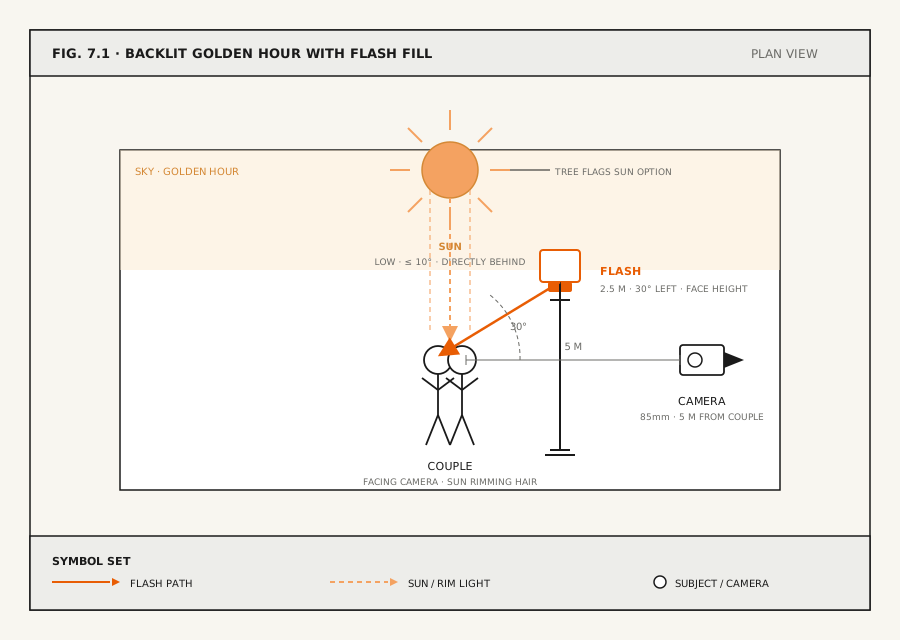
- SUN: low, within about 10° of the horizon, directly behind the couple
- COUPLE: facing camera, sun rimming hair and shoulders
- CAMERA: 5 m from couple, 85mm, sun just out of frame or flagged by a tree
- FLASH: on a stand, 2.5 m from couple, 30° camera left, at their face height
- START: about 1/16 power at ISO 200 · at or below sync speed, no HSS needed
- CHECK: faces on the histogram · let the sky render bright behind
The measured figures here come from one study measuring one set of locations, none of them weddings, and the sky model numbers are design calculations rather than readings; both are anchors for orders of magnitude, not predictions of your venue on your date. The golden hour cadence replaces a falloff table because no measured falloff table entered our source record: when one does, the numbers will appear here with their instrument and conditions named, and not before.
Frequently asked
When exactly should we schedule couple portraits?
Work backwards from sunset for your date and place, and protect the final 40 minutes or so of direct sun for the couple. Sunset time is precisely computable for any date and location; how the light behaves inside that window still varies with weather, so build the timeline to sunset and keep the cadence of checks from this chapter.
Do I need a reflector instead of flash for fill?
A reflector is silent, cheap, and honest about what it does when you can see it doing it. It needs someone to hold it and it cannot exceed the light it receives. Flash fill works unattended from a stand and scales. No published efficiency figures exist for reflector fabrics in our source record, so with either tool the procedure is the same: test frame, histogram, adjust.
Harsh sun, no shade anywhere. What is the order of moves?
Turn the couple’s backs to the sun so faces fall into their own shadow, expose for the faces, and accept a bright background. If the background clips into meaninglessness, add flash fill and take the exposure down toward the sky. Only then reach for high speed sync, knowing from this chapter roughly what it will tax.
SOURCES
- Bhandary, S.K., Dhakal, R., Sanghavi, V. and Verkicharla, P.K., “Ambient light level varies with different locations and environmental conditions”, PLoS ONE, doi.org/10.1371/journal.pone.0254027. Open sky, translucent shade, enclosure, and the cloudy day band it cites are from its tables; measured with a named, factory calibrated lux meter.
- Jacobson, R.E., Ray, S.F., Attridge, G.G. and Axford, N.R., The Manual of Photography, 9th edition, Focal Press, 2000, for the exposure value arithmetic reducing to the factor of two equivalence between stops; paraphrased because the freely readable copy is a scanned text.
- Canon Speedlite EL-1 Advanced User Guide, normal and high speed sync guide number tables, cam.start.canon, fetched 2026-08-04. The conversion of Canon’s guide numbers into stops is our derivation, shown in the text.
- CIBSE, “Daylighting and Compliance”, cibse.org: modelled diffuse horizontal illuminance for the standard overcast and clear sky models, for one date and time. Design calculations, not measurements; fetched 2026-08-04.