Why is every reception photo orange, and what do you do about it?
Flash is daylight blue, the room is tungsten orange, and no white balance slider fixes both at once. The gel arithmetic that reconciles them, worked in full, plus what overpowering the room really costs.
KEY TAKEAWAYS
- Mixed light means two sources at two colors in one frame. White balance is one slider; it can be right for the flash or right for the room, never both. The fix happens at the flash, not in post.
- Gel choice is checkable arithmetic, not folklore. Worked below: for matching flash to a tungsten room, a ¾ CTO lands about 70 K warm, while the full CTO everyone reaches for overshoots by hundreds of kelvin.
- Every gel costs light, and the cost is published: a full CTO passes about 55 percent, which is about 0.85 stops. The arithmetic for any gel is one logarithm, shown below.
- Overpowering the room with high speed sync costs real power. Canon’s own tables put the penalty near a stop and a half at 1/125, approaching two stops at 1/250, derived below from their published guide numbers.
Two colors, one slider
Your flash fires at daylight color, somewhere around 5500 K. The ballroom’s bulbs and string lights burn around 3200 K, far warmer. Put both in one frame and set white balance for the flash: everyone your flash reaches looks right and the room behind them glows orange. Set it for the room instead: the room looks right and your flash lit subjects turn blue. There is no third slider position, because the frame genuinely contains two different colors of light. That is mixed lighting, and it is the default condition of every reception after sunset.
You have three honest options. Convert the flash to the room’s color with a gel, then white balance for tungsten and everything agrees, warmly. Overpower the room so the flash is the only light that matters, and the room goes dark and neutral behind the couple. Or embrace the mix deliberately, DJ colors and all, the way the reception settings chapter’s dance floor row does. The first two have arithmetic, so this chapter does them properly.
The gel arithmetic, worked in full
Color temperature converts to a unit that makes gel math into subtraction: the mired, defined in the standard reference as one million divided by the temperature in kelvin.1 Gel makers publish each filter’s mired shift, positive for warming, negative for cooling, so the whole method is: mireds of the target, less mireds of your flash, then find the gel with the nearest shift.
Worked, for the standard wedding case, flash into a tungsten room. The room: 1,000,000 divided by 3200 is 312.5 mired. The flash: 1,000,000 divided by 5500 is about 181.8 mired. The shift you need is the difference, about 131 mired of warming. Now check the shelf. Lee’s ¾ CTO is published at plus 124: applied to the flash, 181.8 plus 124 is 305.8 mired, and 1,000,000 divided by 305.8 is about 3270 K, roughly 70 K warmer than the room. Lee’s full CTO is published at plus 159: that lands at 340.8 mired, about 2934 K, overshooting the room by some 266 K.2 The ¾ CTO is the correct gel, and the full CTO everyone defaults to overshoots, because a full CTO is computed to convert 6500 K daylight, not a 5500 K flash. Every step above is one division you can redo on a phone, and when we ran this method against seven published manufacturer conversion claims from Lee and Rosco, it reproduced all seven within their own rounding.
Gels also cost light, and this number is published too, as transmission. The cost in stops is the log base 2 of one over the transmission. Lee’s full CTO is published at 55.4 percent: one over 0.554 is 1.81, and the log base 2 of 1.81 is about 0.85, so budget about a stop. A full CTB, published at 34 percent, costs about 1.56 stops, which is why converting flash to daylight through blue gel is so much more expensive than warming it.2
Overpowering the room, and what it costs
Option two is to make the room irrelevant: enough flash, at a fast enough shutter, that ambient contributes nothing. Two facts from the camera makers’ own documents set the boundaries. First, sync speed is not one number and not a cliff. Canon’s R6 Mark II specifies 1/200 with the mechanical shutter and 1/250 with electronic first curtain, two sync speeds in one body.3 Nikon’s D750 specification states that between 1/200 and 1/250 the guide number is reduced: past sync, the flash does not vanish, it fades.4 And Sony qualifies the a7 III’s 1/250 as applying when using a flash manufactured by Sony, which warrants nothing about the third party trigger on your bracket.5 Read your own body’s manual line, not a forum summary of it.
Second, high speed sync costs output, and for once the cost is quantifiable from published figures. Canon publishes a separate guide number table for the EL-1 in high speed sync, indexed by shutter speed: at the 200mm zoom position and ISO 100, the normal guide number of 60.0 meters becomes 37.3 at 1/125 and 31.8 at 1/250.3 Convert those to stops, twice the log base 2 of the ratio: 60 over 37.3 is 1.61, giving about 1.4 stops at 1/125; 60 over 31.8 is 1.89, giving about 1.9 stops at 1/250, and the penalty grows as the shutter shortens. Two honesty labels travel with that: the guide numbers are Canon’s, the conversion to stops is ours, and the figures are for one Canon flash. Nikon publishes no equivalent, so treat the size of the penalty as brand specific even though its direction is physics.
The practical consequence: overpowering works best when you do not pay the toll at all. Stay at or under sync speed, bring the flash close, and spend ISO on the ambient side only when you want the room back. High speed sync is for sun, covered in the outdoor chapter; indoors at night you almost never need it, and it quietly halves your flash when you leave it on.
Starting points
| SCENARIO | ISO | SHUTTER | APERTURE | FLASH | CHANGE THIS FIRST |
|---|---|---|---|---|---|
| Tungsten room, gelled flash, WB tungsten | 1600 | 1/160 | f/2.8 | 1/8 + ¾ CTO | Flash power: the gel ate about a stop |
| Overpower: dark neutral room behind couple | 400 | 1/200 | f/4 | 1/2 | ISO down if the room still reads |
| DJ color kept, flash carries faces | 2500 | 1/60 | f/2.8 | 1/16 | Shutter, to taste on the color |
| Window daylight + tungsten interior, day | 800 | 1/160 | f/2.8 | 1/16, no gel | Position: keep faces in one light |
Starting estimates. Assumes a full frame body, a 35mm or 50mm prime, one manual speedlight, and Lee or Rosco polyester gels. Powers are seeds for a test frame; the gel row already budgets the roughly one stop the ¾ CTO costs. White balance settings assume raw capture.
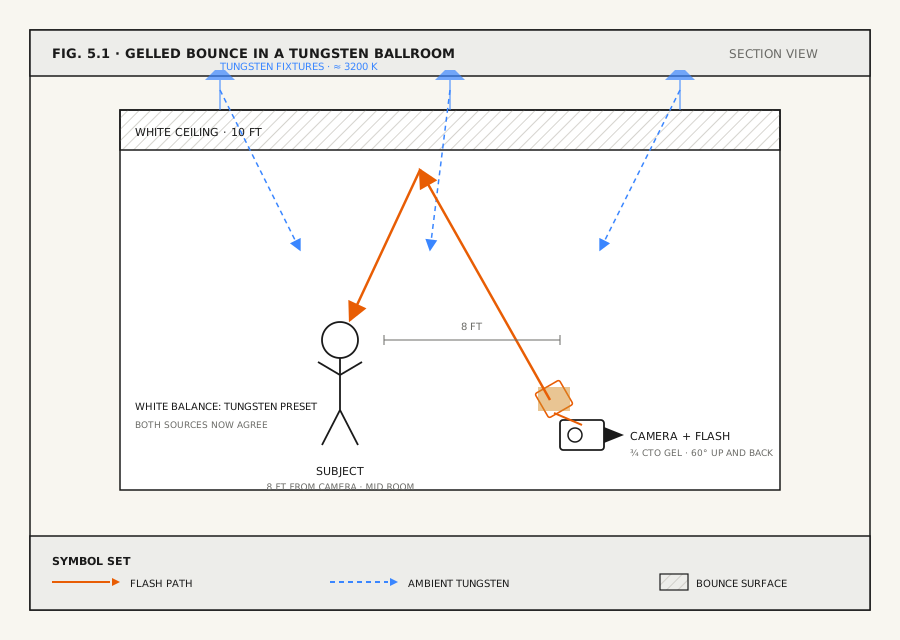
- ROOM: tungsten fixtures about 3200 K throughout · white ceiling 10 ft
- FLASH: hotshoe, ¾ CTO gel taped over the head, 60° up and behind
- WHITE BALANCE: tungsten preset, both light sources now agree
- SUBJECT: 8 ft from camera, mid room
- START: about 1/8 power before the gel, expect about one stop more after it
- CHECK: skin neutral AND the room warm but not orange on the back of the camera
The gel arithmetic assumes you know the room’s color, and 3200 K is an assumption, not a measurement: LED house lights masquerade as tungsten at any color their installer chose, and DJ fixtures change by the song. When the room’s color is unknowable, the arithmetic has no input, so gel for the dominant steady source, or stop matching and overpower instead. The high speed sync figures are one Canon flash’s published tables; other brands publish no equivalent, and we will not extend one maker’s numbers to another’s hardware.
Frequently asked
Can I just fix the color in post since I shoot raw?
You can move one slider, which corrects one light. A frame holding two colors of light has no single correct setting: fix the faces and the room shifts, fix the room and the faces shift. Local corrections can rescue individual frames, but a night of dance floor images edited one by one is the expensive version of taping a gel on once.
Where do I buy gels and which do I need?
Any film and theater lighting supplier sells polyester gel sheets for a few dollars; cut them to the flash head and tape the edges. A ¾ CTO and a ½ CTO cover the warming cases at a wedding. Skip the rainbow sample packs until something in this chapter demands otherwise.
What is the mired number for my LED lit venue?
Unknown until you measure it, and that is the honest answer. LEDs are sold at every color from 2700 K up, and venue installers mix them. Take a gray card frame or read the neutral wall in the raw file’s white balance picker, convert with one million divided by kelvin, and run the same subtraction this chapter worked for tungsten.
SOURCES
- Jacobson, R.E., Ray, S.F., Attridge, G.G. and Axford, N.R., The Manual of Photography, 9th edition, Focal Press, 2000. The mired definition and its use for filter selection are stated there; paraphrased because the freely readable copy is a scanned text.
- Lee Filters and Rosco Cinegel published product technical data: mired shift and transmission values per filter, from the manufacturers’ own filter data sheets. The specific values used above: Lee 285 at plus 124, Lee 204 at plus 159 with 55.4 percent transmission, Lee 201 at 34 percent transmission.
- Canon EOS R6 Mark II Advanced User Guide (sync speeds) and Speedlite EL-1 Advanced User Guide, high speed sync guide number table, cam.start.canon, fetched 2026-08-04.
- Nikon D750 specifications, Nikon Japan product pages: flash sync at 1/200 with the guide number reduced between 1/200 and 1/250, fetched 2026-08-04.
- Sony a7 III Help Guide specifications: flash sync speed 1/250 stated as when using a flash manufactured by Sony, fetched 2026-08-04.